


Āti Awa Toa Hauora Partnership Board opposes moves to push vaping on Māori providers as rangatahi harm escalates
Āti Awa Toa Hauora Partnership Board opposes moves to push vaping on Māori providers as rangatahi harm escalates
The Āti Awa Toa Hauora Partnership Board is condemning moves to pressure Māori health providers into supplying vaping products as part of quit-smoking services, warning that it puts whānau health at risk and undermines kaupapa Māori approaches to hauora.
The board stands alongside Takiri Mai te Ata Trust, following Whatu Ora’s announcement threatening to end the trust’s smokefree contract if they don’t supply vaping devices.
“We fully support the Trust’s work to help whānau quit smoking in ways that are safe, sustainable, and aligned with their oranga values and kaupapa. Encouraging young people to remain addicted to nicotine is not a kaupapa we support,” said board Manahautū, Hikitia Ropata.
The board’s recently released Whānau Voice report showed whānau across the region were deeply concerned about the impact vaping was having on young people.
Takiri Mai te Ata Trust has supported whānau across Wellington, Porirua and Te Awa Kairangi for decades through culturally grounded stop-smoking programmes. The Trust has declined to distribute vaping products, citing concerns about nicotine addiction, rangatahi harm, and the normalisation of vaping in community and marae settings.
Ms Ropata says the reality on the ground and across communities is already clear.
“Our rangatahi are not quitting smoking and switching to vaping – most are starting out as vapers and have never smoked. Vapes are cheaper than cigarettes.”
Recent data shows that the highest vaping rates in Aotearoa are now among 14-year-old Māori girls.
“This is not harm reduction. This is government support for addiction.”
Ms Ropata says the Whaitua geo-mapping tool shows us vaping products are heavily concentrated in lower-income communities, with vape shops found close to kura and schools, making nicotine addiction highly visible and accessible to young people.
“Normalising vaping in our communities means siding with tobacco companies over our most vulnerable whānau, our tamariki and rangatahi.”
The Board is calling on the Government to work in partnership with providers, not against them.
“Māori health providers must be trusted to exercise kaupapa-based judgement informed by whānau voices.”
Whaitua Geo-Mapping Tool: https://reports.hqsc.govt.nz/
Whānau Voice Report: https://atiawatoaimpb.nz
For more information contact Christine Ammunson 0274457333 or christine.ammunson@roheora.nz

Kapa Haka and Connection Identified as Major Drivers of Oranga in Newly Released Whānau Voice Insights Report 2025
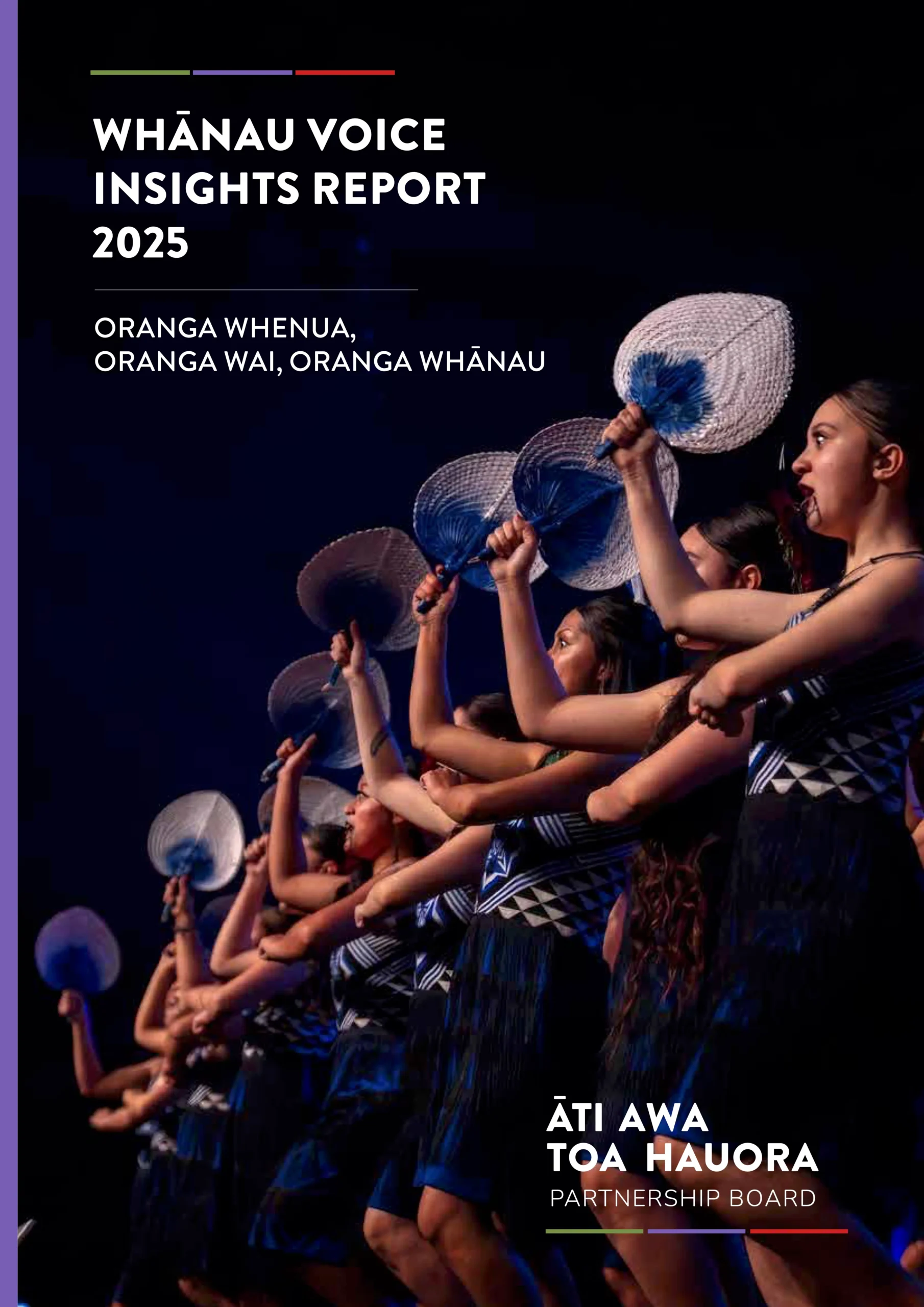
Kapa haka and the importance of connection emerged as major contributors to whānau oranga in the newly released Whānau Voice Insights Report 2025, with warnings about the impact vaping is having on rangatahi also highlighted.
“Whānau shared how kapa haka and connection uplift oranga – strengthening identity, whakapapa, te reo and a deep sense of belonging. They spoke of kapa haka as a source of pride and collective strength, and how connection to culture, whenua and trusted relationships are essential to oranga,” said Hikitia Ropata, Āti Awa Toa Hauora
Partnership Board Manahautū.
“At the same time, whānau raised concerns about vaping among rangatahi, the cost of dental care for adults, long waits and the lack of Māori-led services. Their voices should help guide decision makers: invest in what keeps whānau connected and thriving and challenge the barriers that hold whānau back.”
Whānau described kapa haka as strengthening identity, pride, te reo, whakapapa and whanaungatanga, while supporting discipline, fitness and deep mental and spiritual wellbeing (Te Ihi, Te Wehi, Te Wana).
“Across the region, whānau consistently emphasised the importance of connection – to culture, to whānau, to whenua and to trusted people within the health system.”
The report coincides with Māwharu in the Maramataka, a phase associated with Whakatau (mental wellbeing) and Whakaora (physical wellbeing).
“The themes shared by whānau align closely with the meaning of this phase: oranga is built through connection to each other, to culture, and to services that understand our realities,” said Ms Ropata.
Whānau insights were also gathered from kapa haka performers, support crews and whānau attending Te Matatini, confirming the deep cultural and social value kapa haka provides across our rohe.
Summary of Key Findings
Whānau identified several barriers that disrupt their connection to care, including high costs, long waits, transport challenges in rural areas, workforce shortages, and a lack of culturally safe, Māori-led services. Despite being enrolled with primary care, many still cannot access timely or affordable support, with access to mental health support particularly poor (60% reporting difficulties).
Whānau also raised strong concerns about rising vaping among rangatahi and the easy availability of vape products near kura. They want kaupapa Māori cessation pathways, tighter regulation, and earlier prevention efforts, delivered by trusted Māori providers.
Immunisation is generally supported, but hesitancy remains. Whānau prefer vaccinations delivered by Māori providers, in trusted places such as kura, kōhanga and marae, where connection drives engagement.
Across all findings, the message is consistent: strengthen connection to people, culture and place; invest in services by Māori, for Māori; and build a strong Māori workforce supported by prevention-focused, te ao Māori–grounded approaches. These insights provide clear direction for future commissioning and system change
Press Release - Ati Awa Toa Annual Report 2025
Āti Awa Toa IMPB releases 2024-2025 Annual Report: Whānau-led change and major data innovations
The Āti Awa Toa Hauora Partnership Board has released its 2024–2025 Annual Report, highlighting improvements across access, immunisation, early-years support, cultural safety, and the use of local data to drive better decision-making in the region.
Manahautū Hikitia Ropata says the results show both progress and urgency:
“We are beginning to see real movement in areas where there has been sustained effort – from rising immunisation rates to notable increases in cervical screening rates for Māori. These gains show what’s possible when focus and partnership align.”
Across the year, whānau shared clear priorities: timely access to care, affordability, cultural safety, and joined-up services close to home.
Māori pēpi immunisation increased sharply from 66% to 81%, while cervical screening for Māori rose from 56% to 71%.
“There is still a long way to go. Whānau continue to face long stays in ED, unacceptable wait times for first specialist appointments and elective surgery, cost barriers and long waits for primary and oral health care and inconsistent cultural safety. These are system issues, and they require system change.”
This year also marked the launch of two major tools:
- Whaitua – a geo-mapping tool that makes local data visible to whānau and oranga providers
- Monitoring for Oranga – a tikanga-bound framework redefining Māori wellbeing measures
“Whaitua has changed the landscape – it returns knowledge to the people it belongs to,” says Ropata.
“Developed with support from Te Tāhū Hauora, the Social Investment Agency and IMPBs across Aotearoa, the Whaitua geo-mapping tool is the first of its kind in Aotearoa.”
Ropata says the Board remains focused on its statutory role while closely monitoring proposed legislative changes.
“Any changes to the Pae Ora framework must strengthen, not weaken, Māori participation in health decision-making. Our communities expect solutions informed by evidence, including lived experience, and iwi leadership. Whānau outcomes can only improve when Māori are active partners in shaping systemic solutions that affect our lives.”
Ropata paid tribute to the mana whenua iwi of the region.
Tuatahi, tae atu ki ngā kaimahi – ngā mihi aroha ki a koutou i tō koutou kaha, i tā koutou tau toko i ēnei tau. Te Poari, Te Tai Toru ki Kāpiti, ki Parirua, tae atu ki Te Whanganui-a-Tara. Tai Toru: he hono tahi i ngā whānau, i ngā hapū, i ngā iwi me ngā hapori katoa.
“Our kaumatua Taku Parai reminded us this year that the three tides that flow onto each iwi’s shore – even at different tidal times – remain forever connected. They remind us of our shared whakapapa, our collective commitments and responsibilities, both great and small. These tides will never cease to echo the dreams and aspirations of our tūpuna: to strive, to seek, and to uphold Tino Rangatiratanga.”
Looking ahead to Matariki 2026, the Board will focus on expanding kaupapa-led care in every whaitua, strengthening workforce capability, and ensuring equitable investment informed by whānau experience and local data.
The full report is available at: www.atiawatoaimpb.nz
Ati Awa Toa Annual Report 2025
This year, we tell our story through the two periods that guide our mahi: our Maramataka, from Matariki 2024 to Matariki 2025, and the financial year, from 1 July 2024 to 30 June 2025.
Whānau Voice Insights Report 2025
This report affirms that whānau voice is not only critical to understanding the challenges of the health system, but also offers the pathways to solutions.
Whaitua Geo-Mapping Tool: https://reports.hqsc.govt.nz/
Whānau Voice Report: https://atiawatoaimpb.nz
For more information contact Christine Ammunson 0274457333 or christine.ammunson@roheora.nz