
System change needed to break down barriers facing māmā and pēpi across the region - Āti Awa Toa IMPB
Persistent barriers facing Māori māmā and pēpi across the region highlights the urgent need for earlier, whānau-centred support. The report, Te Oranga o ngā Māmā me ngā Pēpi i tō tātou rohe 2018–2026, highlights ongoing inequities across pregnancy, birth and early life.
“This report makes clear the issue is not a lack of care from whānau but a system that is still too hard to access. We already know that when kaupapa Māori whānau-centred support is there, whānau engage and outcomes improve,” says Board Manahautū Hikitia Ropata.
Released by the Āti Awa Toa Hauora Partnership Board, with support from mana whenua iwi, the report brings together whānau voice and health and wellbeing data from 2018 to 2026 and shows where the system is falling short, and where kaupapa Māori approaches are making a difference.
“System change is needed to make sure our services work well for all families. If some families are being consistently underserved, then it’s time to change the system so it works well for all.”
“For too many Māori māmā and pēpi, getting the right support early is still an obstacle course. This report shows how delayed access to maternity care, poor or insecure housing, and low enrolment of newborn pēpi with primary care are stacking the odds against whānau from the start.”
The report shows barriers are ongoing across the journey from pregnancy through early life. For instance, in 2023, 12.9% of Māori were not enrolled with a lead maternity carer at any stage during their pregnancy. In 2024, Māori women in the rohe missed 28.9% of first specialist maternity appointments, compared with 3.5% for non-Māori, non- Pacific. It also shows inequities continue into early life. As of February 2026, whānau Māori in our rohe had the highest rates of tamariki not fully immunised at 24 months, at 8.8%. Tamariki Māori were also 1.3 times more likely than non-Māori non-Pacific children to experience an avoidable hospitalisation event in 2024.
The findings reinforce that these outcomes are shaped by barriers to access, cost, transport, housing and fragmented systems.
The report calls for:
- earlier engagement with māmā, particularly young māmā and those in high deprivation areas
- improved access to maternity and primary care
- more joined-up support across health, housing and social systems.
- investment in holistic, kaupapa Māori models which whānau use and trust.

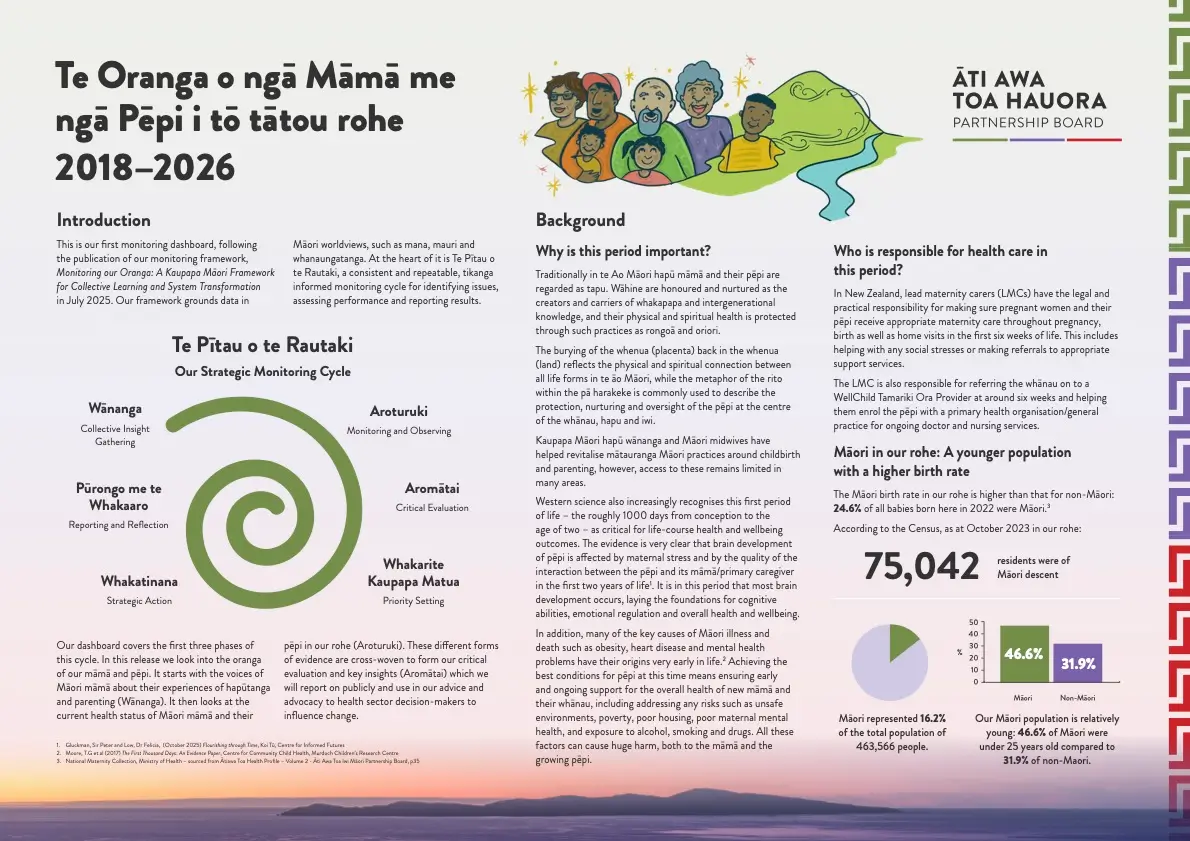
A Summary: Te Oranga o ngā Māmā me ngā Pēpi i tō tātou rohe 2018–2026
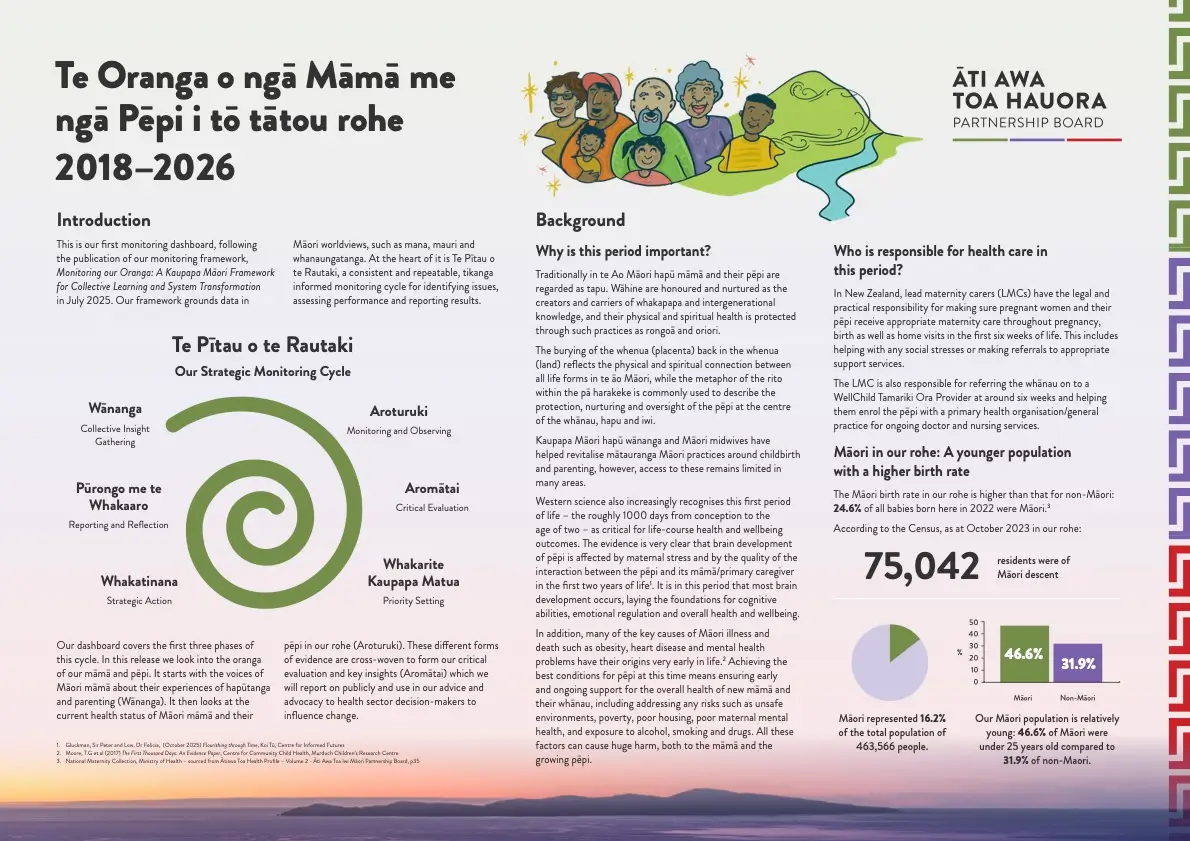
Frequently Asked Questions: Te Oranga o ngā Māmā me ngā Pēpi i tō tātou rohe 2018–2026
This is a local monitoring report researched and drafted by the Āti Awa Toa Hauora
Partnership Board that looks at how well the health and wider system is supporting
Māori māmā and pēpi in our rohe – from pregnancy through early life. It combines
whānau voice with health, housing and social data to provide a fuller picture of both
lived experience and system performance.
The report covers 2018 to 2026, bringing together long-term trends with the most
recent available data to show both progress and persistent inequities.
The report draws on a mix of local and national data sources, including:
- Health data (maternity care, immunisation, hospitalisations)
- Housing and social data (deprivation, living conditions)
- National datasets such as Census and Integrated Data Infrastructure (IDI)
- Local service and provider insights
Whānau voice was gathered through wānanga and engagement with māmā and
whānau (2024–2025).
These insights are treated as equally important as quantitative data and are woven
together to shape the report’s findings.
The period from pregnancy through the first two years of life is critical for life-course
health and wellbeing outcomes. The physical and mental health of the māmā and
her broader environment affects the health of the developing baby. It is also in this
period that most brain development occurs, laying the foundations for life.
Māori māmā and pēpi continue to experience inequitable outcomes across multiple
areas – including poorer access to health care, quality housing, and early support.
The report shows these outcomes are driven by system barriers, including:
- Late or difficult access to services
- Cost and affordability
- Transport challenges
- Poor or insecure housingFragmented or hard-to-navigate systems
The report highlights the real-life experience of many whānau trying to access care;
needing to overcome multiple barriers just to get basic support.
Yes. Some improvements are being seen, such as rising immunisation rates.
However, inequities remain significant.
- Investment in kaupapa Māori, whānau-centred models of care
- Earlier and more proactive engagement with māmā
- Improved access to maternity and primary care
- More coordinated, joined-up services
Services that are: kaupapa Māori – whānau-centred – accessible and trusted
consistently show better engagement and improved outcomes.
Health sector leaders, government agencies, and commissioning bodies all have a
role in improving access, investing in effective models, and addressing wider system
barriers.
The findings will inform ongoing monitoring, advice to decision-makers, and future
investment and planning to improve outcomes for Māori māmā and pēpi.
Purpose
This report provides a summary of the oranga of Māori māmā and pēpi across our Āti Awa Toa Iwi Māori Partnership Board rohe, combining whānau voice with health, housing, and social sector data to assess how well the system is working and where change is needed. It is a monitoring dashboard within a kaupapa Māori framework and is designed to support ongoing system learning and transformation.
How the report was developed
The report draws on multiple sources of evidence across the period 2018–2026,
including:
- Wānanga and engagement with māmā and whānau (2024–2025)
- Health sector data (e.g. maternity care, immunisation, hospitalisations)
- Housing and social data, including deprivation and living conditions
- Local and national datasets (e.g. Ministry of Health, IDI, Census)
Collectively, these sources provide a fuller picture of both lived experience and system performance.
First two years of life
The period from pregnancy through the first two years of life is critical for long-term health and wellbeing. Getting this stage right improves lifelong outcomes; getting it wrong significantly increases the likelihood of poorer health, development and wellbeing over time.
Accessing Early Support
For too many Māori māmā and pēpi, accessing early support is still an obstacle course. Barriers such as cost, transport, housing conditions and fragmented services mean whānau are often unable to access care early, consistently or in ways that work for them.
Findings
Late or no access to maternity care: In 2023, 12.9% of Māori māmā were not enrolled with a Lead Maternity Carer at any stage during pregnancy.
Missed access to specialist care: In 2024, Māori women missed 28.9% of first specialist maternity appointments, compared with 3.5% for non-Māori non-Pacific women.
Inequities continue into early childhood: As at February 2026, Māori tamariki had the highest rate of not being fully immunised at 24 months, at 8.8%.
Higher rates of preventable harm: In 2024, tamariki Māori were 1.3 times more likely to experience an avoidable hospitalisation event than non-Māori non-Pacific children.
Housing and deprivation are affecting health: Poor and insecure housing conditions are strongly linked to higher rates of illness and hospitalisation for tamariki.
What this tells us
These outcomes reflect structural barriers within the system – including access, affordability, service design and wider social conditions.
What is working well
The report highlights that where services are:
– kaupapa Māori
– whānau-centred
– accessible and trusted
then whānau engage earlier and outcomes improve. Local models show the effectiveness of integrated, relationship-based support.
What needs to change
– Earlier engagement with māmā, particularly young māmā and those in high
deprivation areas
– Improved access to maternity and primary care
– More coordinated support across health, housing and social systems
– Investment in holistic, kaupapa Māori models that whānau use and trust.
Change the system
The evidence from 2018–2026 shows that these inequities are persistent and systemic. If we want better outcomes, we need to fix the barriers within the system – not expect whānau to successfully navigate around them.

Āti Awa Toa IMPB launches Whānau Voice Grants
Āti Awa Toa Iwi Māori Partnership Board has launched a new grants fund to support whānau, hapū, marae and kaupapa Māori organisations to share their lived experiences, insights, and solutions for improving hauora across the Āti Awa Toa Hauora Partnership Board rohe.
Four grants of $5,000 are available for kaupapa that centre whānau voice and help strengthen understanding of what is needed to improve health and wellbeing.
Applications open on 30 March 2026 and close at 9am on 4 May 2026.
Manahautū, Hikitia Ropata says the grants are about backing the knowledge that already exists within whānau and communities.
“Whānau understand their own health journeys. The insights that come from our homes, marae and communities are powerful, and they deserve to be heard and learned from. These grants are about supporting whānau to lead that kōrero in ways that work for them.”
The fund is designed to support a wide range of kaupapa Māori approaches. Projects could include hui, wānanga, storytelling, interviews, short films, creative projects, rangatahi or kaumātua conversations, digital storytelling, photography, art, or other community-led ways of gathering and sharing whakaaro.
“There is no single model applicants must follow. What matters most is that projects are grounded in kaupapa Māori, reflect lived experience, and help bring forward whānau voice,” said Ms Ropata.
Insights gathered through the funded projects will help inform future health planning and decision-making across the rohe.
Whānau, hapū, marae and kaupapa Māori organisations across the rohe are encouraged to share the opportunity through their own networks.
Applications open: 30 March 2026
Applications close: 4 May 2026
Funding available: Up to four grants of $5,000
For support or to request an application form, contact: grants@atiawatoaimpb.nz